Can the IRS Freeze Your Bank Account Without Warning?
Generally, no. The IRS usually must send a Final Notice of Intent to Levy and a notice of your hearing rights at least 30 days before a levy. Still, a levy can feel sudden if earlier notices went to an old address, were ignored, or someone else handled them.
“Freeze” is everyday language.
The IRS action is usually called a bank levy, which is different from a federal tax lien.
Can the IRS Legally Levy Your Bank Account?
Yes, once required steps are complete. A levy is a legal seizure of property, including money held in a bank account, to satisfy a tax debt. Generally, the IRS must assess the tax, send a Notice and Demand for Payment, and confirm the balance remains unpaid before it sends a final levy notice.
Does the IRS Have to Warn You First?
Generally, yes. The IRS generally mails a notice of your right to a Collection Due Process (CDP) hearing 30 days before it levies. The IRS generally sends notices to your last known address, and whether a particular notice was properly sent depends on the facts. The law does not require the IRS to call, email, or text you before a levy.
There are limited exceptions. According to the IRS, the notice may come after the levy when collection is in jeopardy, for state tax refund levies, for disqualified employment tax levies, and for federal contractor levies.
Which IRS Notices May Come Before a Bank Levy?
The sequence varies. Many taxpayers first receive balance-due notices such as CP14, CP501, or CP503.
The IRS describes the CP504 notice as a Final Notice and Notice of Intent to Levy that may lead to a state tax refund levy and other collection steps, subject to applicable CDP rights. It does not mean your bank account will be levied immediately.
The notices that typically explain your hearing right and its deadline are the Final Notice of Intent to Levy, such as Letter 1058 or LT11. Read the deadline carefully, because it runs from the date printed on the notice.
What Happens When the IRS Levies a Bank Account?
The bank receives the levy. Funds in the account as of that date and time are frozen. Deposits made afterward are normally not affected.
The bank holds the funds for 21 days. You should not expect to use them during this bank holding period. The IRS says the wait gives you time to contact the IRS, arrange payment, or report errors.
If no release arrives within 21 days, the bank must send the funds to the IRS.
A bank levy generally reaches money already in the account. A wage levy generally continues until released or resolved. The IRS may issue another bank levy later.
Bank Levy vs. Federal Tax Lien
A federal tax lien is the government’s legal claim against your property and property rights. A levy is the actual seizure. A lien does not automatically freeze a bank account, and a levy is not just a claim. The two can occur separately.
Can You Stop or Release an IRS Bank Levy?
No action guarantees a result, but several may matter.
Timely hearing request. You generally have 30 days from the date on the final notice to request a CDP hearing, typically with Form 12153. You can raise collection alternatives, such as an installment agreement. A timely request generally pauses levy while the hearing is pending, though not every collection action (Publication 1660). If you miss the deadline, you may request an Equivalent Hearing within one year of the notice date. It generally does not carry the same Tax Court review rights.
Levy release. Under IRS guidance, the IRS is required to release a levy if it determines that:
You paid the balance.
The collection period ended before the levy.
Release will help you pay.
An installment agreement does not allow the levy to continue.
The levy creates economic hardship, meaning it prevents basic, reasonable living expenses.
The property’s value exceeds the debt, and release will not hinder collection.
Release may also be possible if the levy was premature, improper, or wrongful. The IRS decides whether the requirements are met, and requesting a release does not guarantee one. Release does not erase the debt, and returning money already sent to the IRS follows separate rules and deadlines.
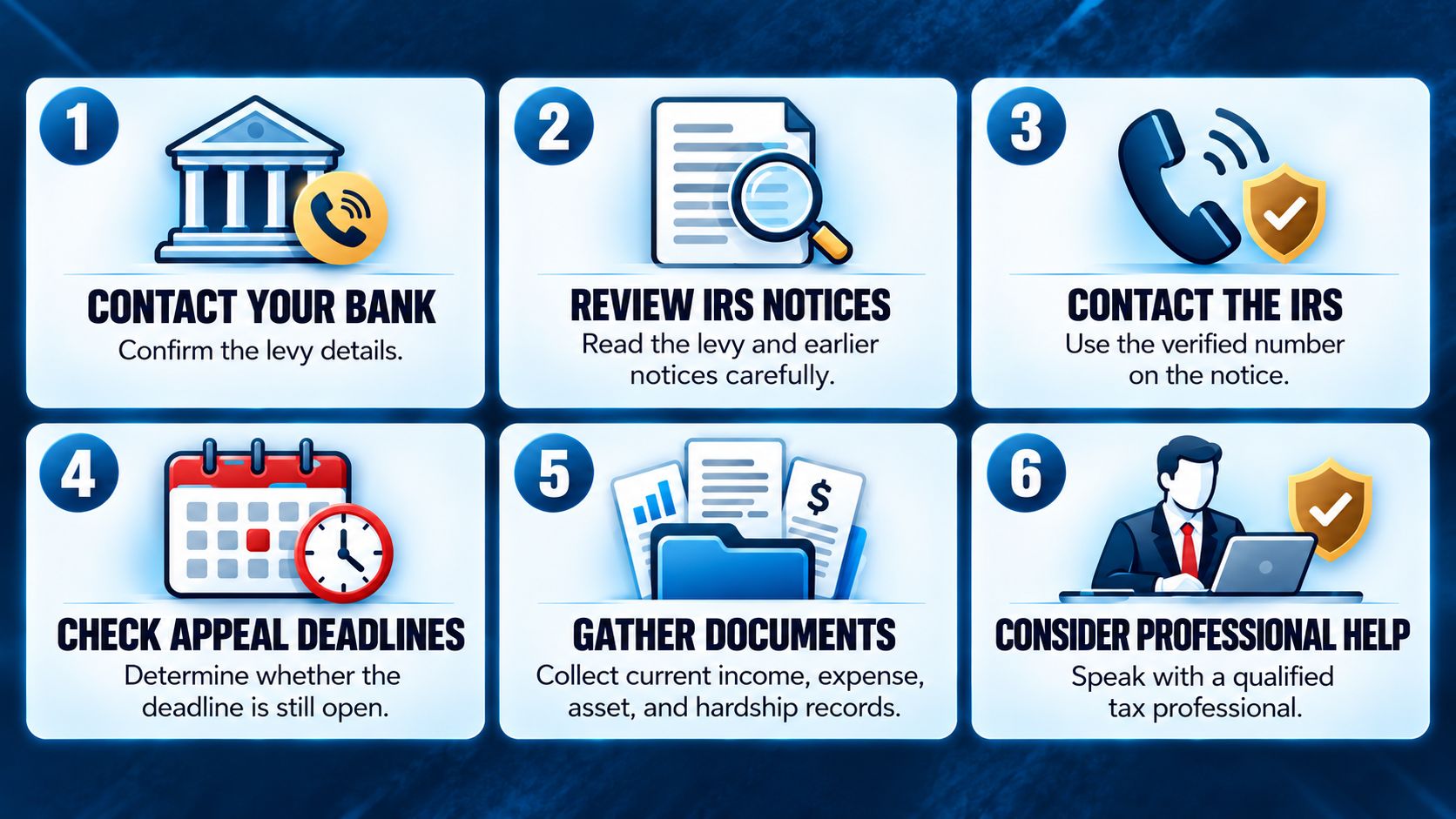
What Should You Do If Your Account Has Been Levied?
Moving or hiding funds to avoid collection is not advisable and may create additional problems.
IRS Resolution Options That May Be Available
Installment Agreement: monthly payments over time.
Offer in Compromise: a settlement for less than the full amount, for those who qualify.
Currently Not Collectible: a temporary pause based on hardship. The debt remains.
Penalty relief: may apply in certain situations.
Each has separate requirements and does not automatically return levied funds.
Can the IRS levy my bank account without notifying me?
Generally, no. A final notice with hearing rights usually comes first, but limited exceptions exist, and notices sent to your last known address may still count.
How much warning does the IRS provide before a bank levy?
Generally, the IRS sends the final notice at least 30 days before the levy.
How long does a bank hold money after receiving an IRS levy?
Under IRS guidance, 21 days. If no release arrives, the bank sends the funds to the IRS.
Can the IRS take the entire balance in my bank account?
A levy generally reaches funds in the account when the bank receives it. The amount affected depends on the levy and the account.
Can money taken through an IRS bank levy be returned?
It may be possible in limited circumstances. After funds reach the IRS, you may file a claim for their return, but claims have separate requirements and deadlines.
Get Help Responding to an IRS Bank Levy
If you received a levy notice or your bank has placed a hold on funds because of an IRS levy, America’s Choice Tax Reliefcan review your situation and explain the response and resolution options that may be available. Levy releases and other outcomes depend on individual circumstances and IRS requirements.
Working from home doesn’t automatically mean a tax deduction or IRS debt relief. Learn what actually qualifies for W-2, self-employed & freelance workers.
Owe back taxes to the IRS? Learn your resolution options – payment plans, Offer in Compromise, and more. Educational guide based on official IRS guidance.
The information provided in this article is for general informational and educational purposes only and does not constitute legal, tax, or financial advice. This content is not intended to replace professional advice from a qualified tax attorney, certified public accountant (CPA), or enrolled agent.
Tax laws and IRS policies are complex and subject to change, and individual circumstances vary. Any actions taken based on the information contained in this article are done at the reader’s own discretion and risk.
No attorney-client or professional relationship is created by reading or relying on this content. For advice specific to your situation, you should consult a qualified tax professional or legal advisor.
Get Your Tax Resolution Started with a FREE Consultation!