IRS Wage Garnishment in 2026: What You Need to Know
There is no single percentage that applies to every taxpayer. People search for “IRS wage garnishment,” but the IRS generally calls this action a wage levy. Instead of taking a fixed share, the IRS uses its tables, your filing status, and your dependents to calculate how much of your take-home pay is exempt from levy. A wage levy can continue across pay periods. If one affects your paycheck, review your notices promptly and consider the options available to you.
What Is an IRS Wage Levy?
A levy is a legal seizure of property, and the IRS notes it can reach wages. Your employer receives the levy and sends part of each paycheck to the IRS.
This differs from ordinary income-tax withholding, which generally advances your current-year tax based on your Form W-4. A levy collects an overdue balance you already owe.
How Much of Your Paycheck Can the IRS Take?
The IRS sends your employer Publication 1494, which explains the exempt amount. That amount is based on the standard deduction and the number of dependents you can claim for the year the levy is served. Key factors include:
Filing status
Number of dependents claimed
Pay frequency (daily, weekly, biweekly, semimonthly, or monthly)
Other income sources
If you have other income sources, the IRS may, in some cases, allocate your exemptions to another source and levy 100% of one employer’s income.
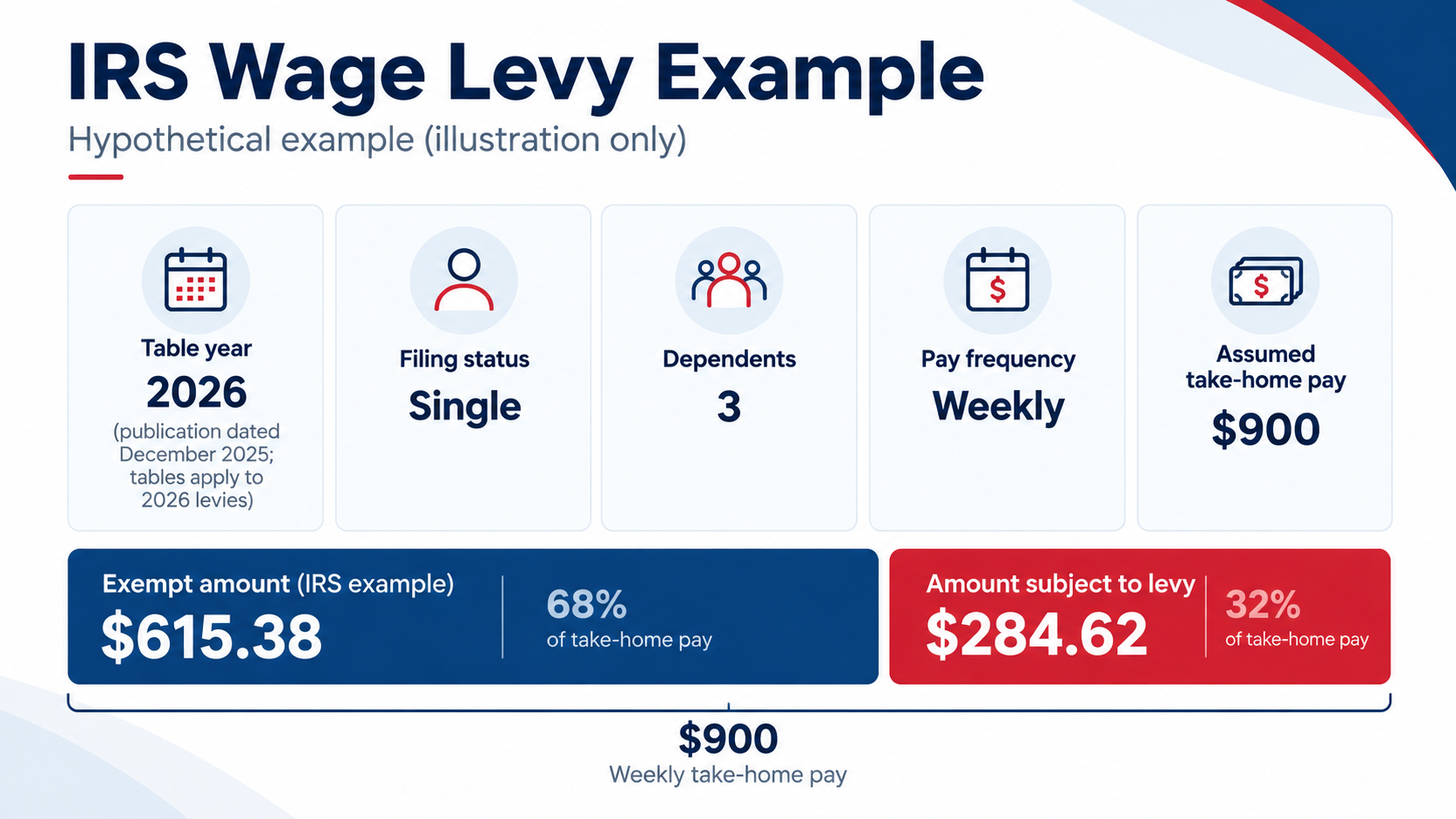
Hypothetical example (illustration only):
Table year: 2026 (publication dated December 2025; tables apply to 2026 levies)
Filing status: Single
Dependents: 3
Pay frequency: Weekly
Assumed take-home pay: $900
Exempt amount: $615.38 (IRS example)
Illustrative amount subject to levy: $284.62
Your exempt amount depends on your facts and the table for the applicable year.Biweekly and semimonthly (twice-monthly) pay use different table columns.
Why the Employer’s Exemption Statement Matters
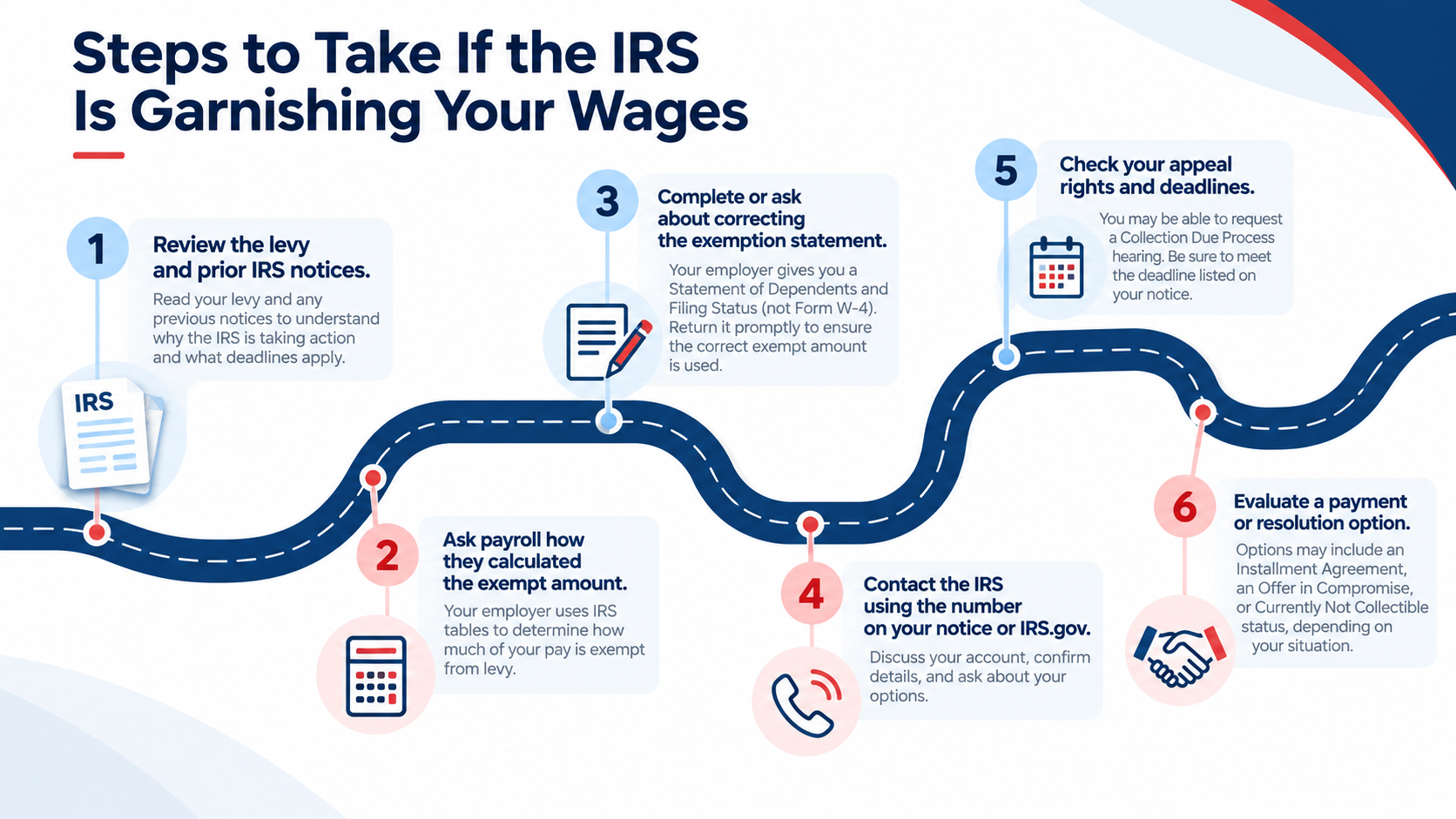
Your employer gives you a Statement of Dependents and Filing Status. It is not Form W-4. The IRS says you should return it within three days. If you don’t, the IRS calculates your exempt amount as married filing separately with no dependents, which can mean more of your pay is taken.
Does the IRS Have to Notify You First?
The IRS generally sends a Final Notice of Intent to Levy and Notice of Your Right to a Hearingat least 30 days before a seizure. Exceptions include jeopardy, state tax refund levies, federal contractor debts, and certain employment tax levies.
To request a Collection Due Process hearing, submit Form 12153 by the deadline printed on your notice. For proposed levies, that is 30 days from the letter date. A phone call may not preserve your hearing rights.
How Long Can IRS Wage Garnishment Continue?
It is not a one-time deduction. The IRS serves a wage levy once, and it continues until you pay the debt, make other arrangements, the collection period ends, or the IRS releases the levy.
A bank levy is different. It takes only what is in the account when the bank receives the levy. A wage levy generally continues until it ends or the IRS releases it. Ask the IRS to confirm your employer has received release instructions.
What If the Levy Leaves You Unable to Pay Living Expenses?
The standard exempt amount doesn’t cover your actual rent, food, or medical bills, so a separate evaluation applies if you request a release. The IRS must release a levy it determines creates an economic hardship, meaning it prevents you from meeting basic, reasonable living expenses.
Contact the IRS at the number on your levy or notice, and be ready to document income, expenses, and assets, since the Taxpayer Advocate Service says a financial statement is often needed.
Keep three things separate:
Releasing the levyshould stop future deductions once your employer processes the IRS release.
Resolving the debtrequires arrangements with the IRS, because a release does not mean you no longer owe the balance.
Returning money already collectedis a separate request with its own rules.
What Steps Can You Take?
Options include an Installment Agreement, an Offer in Compromise, or Currently Not Collectible status, a temporary delay if you cannot pay, though interest and penalties generally continue. Each has separate requirements, and submitting an application or contacting a company does not automatically stop a levy.
Is IRS wage garnishment limited to 25% of my paycheck?
No. The IRS does not apply a fixed percentage to wage levies. It uses exempt-pay tables, and limits for other garnishments don’t apply to an IRS levy.
How does the IRS determine how much pay I can keep?
It uses Publication 1494, based on filing status, dependents, and pay frequency.
Can the IRS release a wage levy because of financial hardship?
It can be. The IRS must release a levy if it determines the levy prevents you from meeting basic, reasonable living expenses.
Does releasing a wage levy eliminate my tax debt?
No. You must still arrange to resolve the balance, or the IRS may reissue the levy.
Get Help Understanding Your IRS Options
If an IRS wage levy is affecting your paycheck, America’s Choice Tax Relief can help you understand the notice and review resolution options that may fit your circumstances. Eligibility and outcomes depend on your financial situation and applicable IRS requirements. America’s Choice Tax Relief is not affiliated with the IRS.
Working from home doesn’t automatically mean a tax deduction or IRS debt relief. Learn what actually qualifies for W-2, self-employed & freelance workers.
Confused about IRS debt? Get clear answers to the most common tax debt questions – from payment plans to liens, levies, and relief options. Know your rights.
The information provided in this article is for general informational and educational purposes only and does not constitute legal, tax, or financial advice. This content is not intended to replace professional advice from a qualified tax attorney, certified public accountant (CPA), or enrolled agent.
Tax laws and IRS policies are complex and subject to change, and individual circumstances vary. Any actions taken based on the information contained in this article are done at the reader’s own discretion and risk.
No attorney-client or professional relationship is created by reading or relying on this content. For advice specific to your situation, you should consult a qualified tax professional or legal advisor.
Get Your Tax Resolution Started with a FREE Consultation!