IRS Tax Debt During the Holidays: Understand Your Relief Options
From Thanksgiving onward, the holiday season is meant for family, gratitude, and time together. But if you owe the IRS, an unopened notice or a balance you haven’t checked in months can be hard to set aside. That kind of worry is common, and options may be available depending on your situation.
Taking the first step is often the hardest part. Learning what you owe and what IRS tax relief options exist can help you replace uncertainty with a clearer picture of what comes next.
Why Unresolved IRS Debt Feels So Heavy
Tax debt rarely stays the same. The IRS notes that interest and some penalties continue to be added to unpaid balances until they are paid in full. Notices may keep arriving, and each one can bring a new wave of stress.
Many people delay because they don’t know where to start. Understanding the main options is a good place to begin.
IRS Tax Relief Options Worth Understanding
The IRS offers several ways to address a balance you can’t pay all at once. Each has its own requirements, and none is guaranteed. The situations below are general examples, not eligibility tests. Only a full review can show which options may apply.
Payment Plans
An IRS payment plan lets you pay what you owe over time instead of in one lump sum. Each type of plan has its own eligibility rules.
When it may be worth exploring: You can afford regular monthly payments but not the full balance today.
Keep in mind that a payment plan does not reducethe original tax owed. Interest and some penalties generally continue to accrue until the balance is paid.
Offer in Compromise
An Offer in Compromise may allow you to settle your tax debt for less than the full amount if you can’t pay in full or doing so would create financial hardship. The IRS evaluates your income, expenses, and asset equity to determine your ability to pay.
Basic requirements include filing all required returns and making required estimated tax payments. Other conditions also apply. The IRS generally won’t accept an offer if you can pay in full through a payment plan or the equity in your assets. As the Form 656-B booklet explains, submitting an application does not ensure acceptance.
When it may be worth exploring: Your income, expenses, and asset equity suggest you may not be able to pay in full, even through a payment plan.
Currently Not Collectible Status
If the IRS determines that you cannot pay because of financial hardship, it may place your account in Currently Not Collectible status. This temporarily suspends most collection activity. The IRS may ask for a collection information statement and documents that support your finances.
When it may be worth exploring: Your financial information shows that paying the debt would leave you unable to cover basic living expenses.
This status does not erase the debt, and penalties and interest continue.
Penalty Relief
IRS penalty relief may reduce or remove certain penalties, but it generally does not eliminate the underlying tax. Two common paths are:
First Time Abate: For taxpayers with a history of timely compliance. The IRS has announced it is phasing in a new Automatic Exemption from Penalty to replace it, beginning in summer 2026.
When it may be worth exploring: Penalties make up a meaningful part of your balance, and you have a history of timely compliance or documented circumstances showing you tried to meet your tax obligations.
Simple Ways to Get Started
You don’t need to have everything figured out to begin. A few practical steps can help:
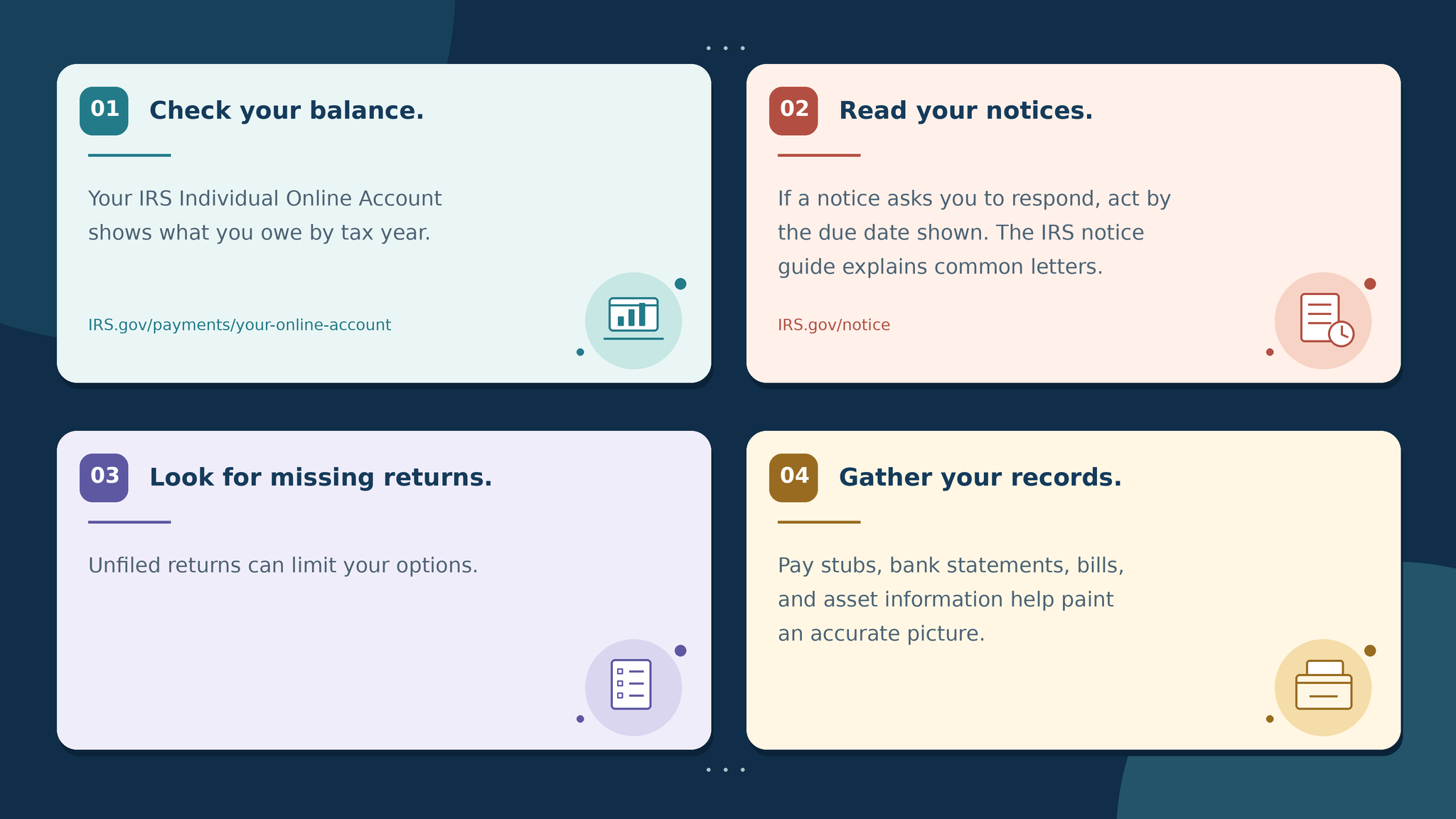
Read your notices. If a notice asks you to respond, the IRS says to act by the due date shown. Its notice guideexplains common letters.
Look for missing returns.Unfiled returns can limit your options.
Gather your records. Pay stubs, bank statements, bills, and asset information help paint an accurate picture.
How a Tax Relief Professional Can Help
Choosing the right IRS option means weighing your income, expenses, assets, filing history, and any deadlines on your notices. A credentialed tax professional, such as an enrolled agent, CPA, or tax attorney, can:
Review your IRS account and notices with you.
Help identify missing returns and compliance issues.
Explain which options may fit your circumstances and why
Help prepare accurate financial information and applications.
The IRS makes all final decisions.
Take the First Step With America’s Choice Tax Relief
If IRS debt has been weighing on you, you don’t have to sort through it alone. Whether you’re behind on payments, facing penalties, or unsure what you qualify for, call America’s Choice Tax Relief to talk through your situation. Our team can review your circumstances and help you understand the options that may be available. Eligibility and outcomes depend on your situation and IRS requirements.
Is there a best time of year to seek IRS relief?
IRS relief isn’t seasonal, but notice deadlines still apply, and interest generally continues to accrue, so a prompt review is usually wise.
Does a payment plan reduce what I owe?
Generally, no. It spreads the balance over time, and interest and some penalties continue to accrue.
Does Currently Not Collectible status forgive my debt?
No. It temporarily delays most collection activity, but the balance remains.
What if I have an IRS notice with a deadline?
Follow the date on the notice. If you have questions, contact the IRS using the number on the notice or speak with a tax professional promptly.
Learn how to find out if you owe the IRS money online. Check your balance by tax year for free on IRS.gov and understand your next steps if you do owe.
Learn how to check your IRS balance by tax year using your Online Account, notices, transcripts, or a phone call, and what to do after you confirm the amount.
Why am I getting a letter from the IRS in 2026? Learn common reasons, how to read your IRS notice number, verify it’s real, and choose your next steps.
Got an IRS letter about unfiled tax returns? Learn how CP59, CP63, and CP2566 notices differ and how to respond whether or not you were required to file.
Working from home doesn’t automatically mean a tax deduction or IRS debt relief. Learn what actually qualifies for W-2, self-employed & freelance workers.
The information provided in this article is for general informational and educational purposes only and does not constitute legal, tax, or financial advice. This content is not intended to replace professional advice from a qualified tax attorney, certified public accountant (CPA), or enrolled agent.
Tax laws and IRS policies are complex and subject to change, and individual circumstances vary. Any actions taken based on the information contained in this article are done at the reader’s own discretion and risk.
No attorney-client or professional relationship is created by reading or relying on this content. For advice specific to your situation, you should consult a qualified tax professional or legal advisor.
Get Your Tax Resolution Started with a FREE Consultation!